
In a fast-moving digital world, and as businesses rely more heavily on the internet, having a beautifully designed website is no longer enough. It must also be fast and easy to browse. This is where Content Delivery Networks (CDNs) stand out as one of the most effective technologies for improving website speed and performance.
In this article, we explain what a CDN is, how it works, the leading services available, and why using one has become essential for providing visitors with a smooth and fast experience.
What is a Content Delivery Network (CDN)?
A Content Delivery Network is a group of servers distributed around the world that work together to deliver digital content such as websites, images, videos, and other files more quickly.
Its main goals are:
- Reducing content loading time for users around the world.
- Improving the user experience by delivering content from the server geographically closest to the visitor instead of relying only on a distant origin server.

How does a CDN work?
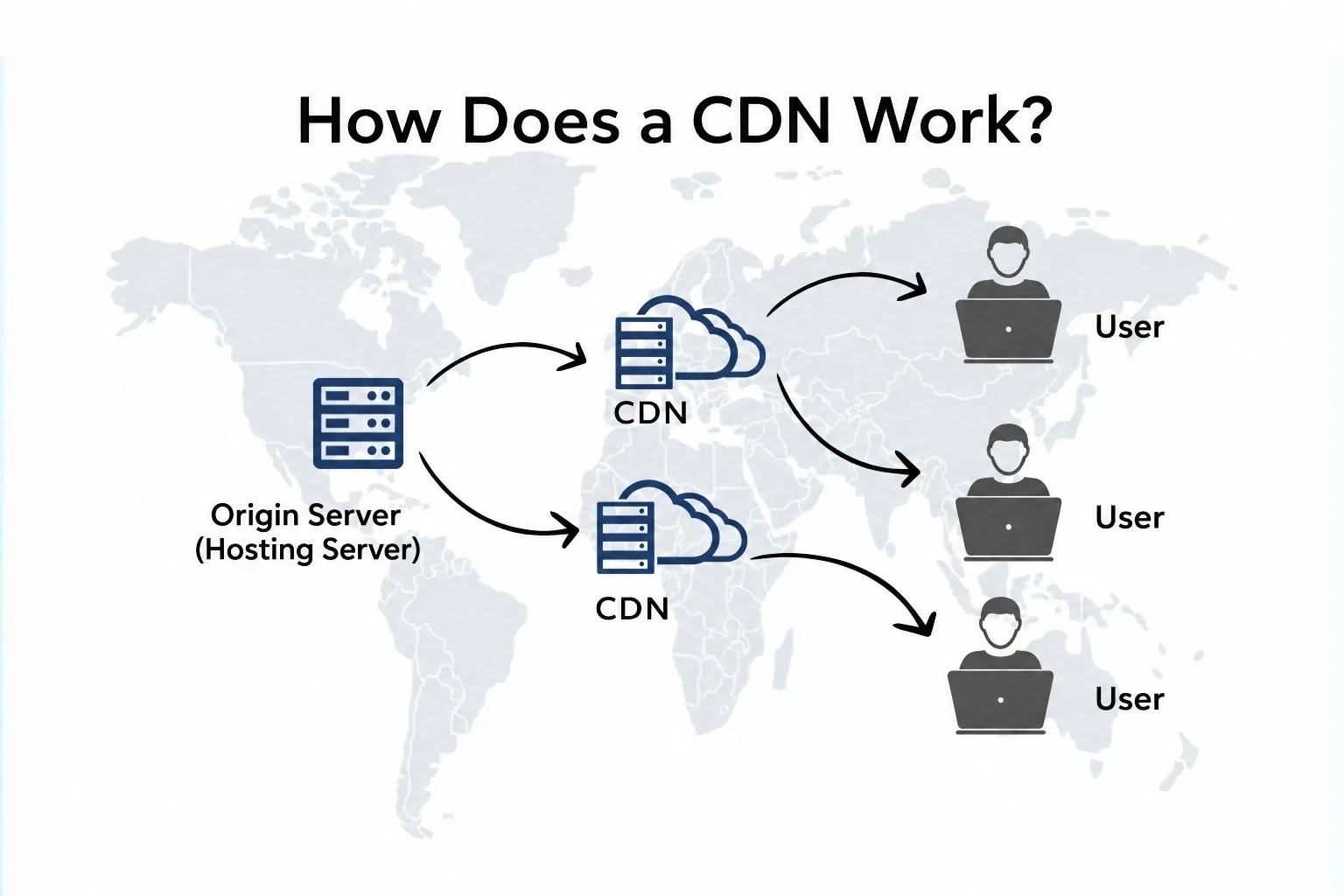
When someone visits a website, the browser requests data from the origin server. If that server is geographically far away, the page may take longer to load. A CDN solves this by serving content from the closest available server, reducing latency and making the website faster.
A CDN generally works through these steps:
- User request: the browser requests the website data.
- Nearest server selection: the CDN identifies the server closest to the user based on location.
- Content delivery: data is sent from that nearby server, accelerating loading and improving the experience.
- Cache updates: cached copies are refreshed regularly so visitors receive current content.
Why use a CDN on your website?
1. Faster loading
A CDN stores copies of website content on geographically distributed servers. Visitors receive the content from a nearby server, dramatically reducing waiting time. This is especially useful for people far from the main hosting server and results in faster pages, images, and videos.
2. Greater stability under traffic
Distributing requests across several servers reduces pressure on the origin server. This helps prevent slowdowns or outages during traffic peaks, promotional campaigns, and product launches.
3. Better security
Many CDN providers include DDoS protection, web application firewalls, and continuous monitoring. These layers reduce online risks and help protect site data and content.
4. A consistent global experience
Because servers are spread across many locations, visitors can receive similar loading speeds wherever they are. Faster performance directly supports satisfaction, session duration, and engagement.
5. Lower bandwidth use and cost
Serving cached content from distributed servers reduces the workload and data transfer required from the origin host. This can lower hosting costs, especially for image-heavy and video-heavy websites.
6. Better search visibility
Fast and stable websites tend to perform better in search. A CDN can improve loading speed, reduce bounce rates, and support a better visitor experience, all of which can positively affect SEO.

Popular CDN providers
Among the best-known CDN providers, QuicCloud and Cloudflare are two strong options. Both can improve speed, security, and user experience, but their strengths differ according to the type of website and its technical needs.
Here is a practical comparison of their services, performance, and pricing.
QuicCloud vs Cloudflare
1. Overview
- Cloudflare: one of the world’s largest CDN networks. It provides CDN delivery, DDoS protection, performance tools, and fast DNS for websites of every size.
- QuicCloud: a CDN developed primarily for WordPress and WooCommerce. It relies heavily on QUIC and HTTP/3 and is optimized for dynamic sites and large media files.
2. Performance
Both services accelerate content delivery. QuicCloud is closely integrated with LiteSpeed Cache, while Cloudflare provides a broad global network suitable for many platforms.
| Criterion | Cloudflare | QuicCloud |
|---|---|---|
| Protocols | HTTP/2, HTTP/3, TLS 1.3 | HTTP/3, QUIC |
| Data centers | More than 300 worldwide | Fewer than Cloudflare, strategically distributed for dynamic sites |
| WordPress optimization | Limited without an additional plugin | Purpose-built support for WordPress and LiteSpeed Cache |
| Image and video acceleration | Supported | Optimized for large files |
| Latency | Very low worldwide | Low, especially for European and Asian websites |
3. Security
- Cloudflare: strong DDoS protection, bot protection, and a web application firewall, with a useful free plan.
- QuicCloud: provides essential content protection but places less emphasis on large-scale attack protection than Cloudflare.
4. Setup and integration
- Cloudflare: requires DNS setup and can be used with almost any website.
- QuicCloud: integrates directly with LiteSpeed Cache and WordPress, making performance setup easier for compatible sites.
5. Pricing
- Cloudflare: offers a free plan, while paid plans begin at around $20 per month and scale according to features.
- QuicCloud: pricing depends on bandwidth and site count and is often economical for small and medium WordPress sites using LiteSpeed.
Your choice should reflect your priorities. QuicCloud may suit a WordPress website that needs direct cache integration, while Cloudflare is often the better fit when you want a comprehensive global CDN with more advanced security services.
Why has a CDN become essential?
If you want a professional website that feels fast and secure, a CDN is no longer merely an optional extra. It speeds up pages, helps keep the website stable during traffic spikes, adds protection against attacks, and makes content consistently available across countries.

Real-world CDN examples
- Video platforms such as YouTube and Netflix use CDNs to deliver content quickly to millions of viewers worldwide.
- Large ecommerce sites such as Amazon rely on CDNs for fast browsing and real-time inventory updates.

Thinking about launching a professional, fast website? I’m Dana Najmah, and I design modern websites that combine elegance with high performance. Contact me through WhatsApp or the contact section, and let’s begin your digital journey with confidence.